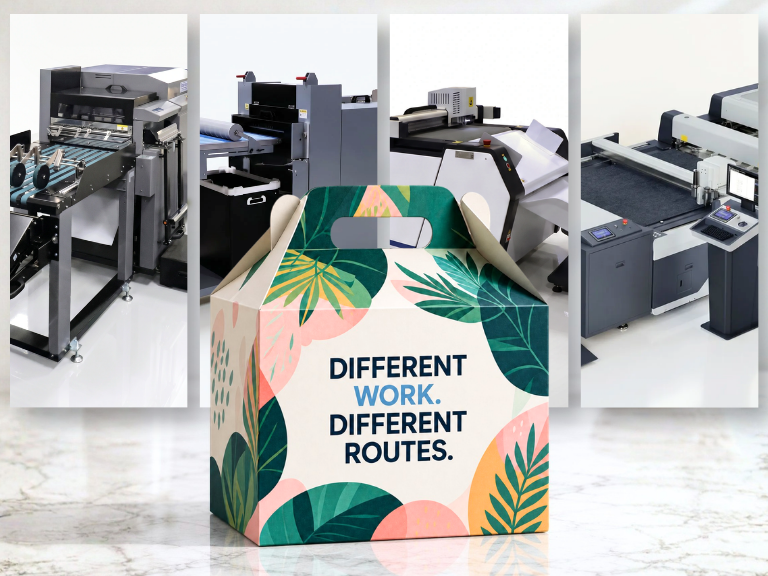
Not every job needs the same cutting route.
In print, shaped work is often spoken about as one opportunity. Packaging, labels, shaped cards, prototypes, folders, displays and rigid applications are grouped together because they all move beyond standard rectangular output. But in production, these jobs are not the same.
A short-run label sheet does not behave like a carton. A prototype does not need the same production logic as a repeat packaging job. A routed display panel creates different demands from a shaped invitation. The shape matters, but so does the route used to produce it.
The right cutting route depends on the work being produced, how often it repeats, the substrate being used, the sheet size, the level of automation required and whether flexibility or repeatability is the bigger priority.
That is why choosing the right digital cutting or die-cutting solution should start with the work itself.
When flexibility matters most
Digital cutting tables are often the right route when shaped work changes frequently, run lengths are shorter and jobs need to move quickly from file to finished application.
A customer may need a small batch of packaging samples, a one-off prototype, a shaped promotional item or a short-run label job. The next job may use a different material, a different size or a different cutting path.
In this environment, flexibility becomes more important than long-run speed.
Digital cutting tables allow print businesses to cut, crease, kiss-cut and score without committing every application to a physical die. That makes them useful for short runs, prototypes, sampling and varied customer requests.
For smaller-format work, the PFi Blade B3+ offers a practical route into short-run packaging, custom-shaped cards, labels, prototypes and smaller production runs. For businesses working at B2 size or looking for greater cutting capacity, the PFi Blade B2+ supports more varied digital cutting work across packaging, shaped print, kiss-cut applications and other short-run products.
The value is not simply being able to produce more shapes. It is being able to move between different types of shaped work with a process that remains manageable.
When repeatability matters most
Die-cutting can become the stronger route when shaped work repeats often, especially when consistency, turnaround and production rhythm become more important than constant job variation.
Some applications have a consistent format. Some customers return with the same packaging, card, tag or label requirement again and again. When that happens, the production question changes.
A digital cutting table may still be the right route, particularly where flexibility remains important. But for repeatable die-cut work, especially where turnaround and volume begin to increase, a die-based process may provide a stronger balance of speed, consistency and efficiency.
The PFi DI-CUT 310 sits in this space. As a compact rotary die cutter, it supports fast turnaround across short-run die-cutting, kiss-cutting, creasing, perforating, slitting, hole punching and round cornering in one process. For businesses producing repeatable smaller-format work, that type of system can offer a different route from digital cutting alone.
The decision is not simply digital cutting versus die-cutting. It is about understanding when flexibility is the priority, and when repeatability starts to influence the most efficient production route.
When B2 sheet size and layout become critical
For B2 shaped work, the right cutting route often depends on sheet utilisation, layout planning and how efficiently the job can move through production.
Packaging, folders, greetings cards and shaped print often depend on how effectively the sheet can be used and how confidently the job can be set up. In these applications, small production details can have a direct impact on margin.
This is where automated B2 die-cutting has a clear role.
The DSM-1000 is designed for short-run B2 die-cutting, with PC-controlled setup, automated job separation and quick make-readies supporting a more consistent process. For businesses producing repeatable shaped work on B2 sheets, this type of automation helps reduce manual touchpoints and gives operators a more controlled route through production.
The key question is whether the work needs the flexibility of a digital cutting table, or whether it has reached the point where automated die-cutting can support a stronger production rhythm.
When material range changes the decision
As shaped work moves into thicker, rigid or more varied substrates, the cutting route needs to support the material as much as the application.
Some print businesses are not only looking at paper-based work. Signage, display, décor, rigid substrates and thicker materials bring a broader range of production demands. Tooling, cutting depth, routing, material handling, nesting and workflow control all become part of the decision.
This is where larger-format digital cutting becomes relevant.
The PFi Blade PRO is designed for businesses looking to bring more complex or larger-format applications in-house. For printers moving beyond short-run paper and board work, that kind of capability can create a more controlled route into wider application opportunities.
Again, the question is not simply what can be cut. It is what can be cut consistently, efficiently and profitably.
Choosing the right cutting route
Shaped work does not have one production answer.
A small batch of prototypes may need a different route from repeat label production. A B2 packaging job may need a different process from a routed display panel. A business testing new applications may value flexibility first, while a business managing repeat demand may value automation, speed and consistency more.
That is why the right cutting solution should be chosen around the work, not just the machine size or headline capability.
For print businesses, the strongest approach is to look at the shaped work they produce now, the work they want to bring in-house, and the applications they want to grow into next.
Duplo’s digital cutting tables and die-cutting solutions support different points on that journey, from compact short-run digital cutting to rotary die-cutting, automated B2 die-cutting and larger-format digital cutting.
Not every shaped job needs the same cutting route.
Choosing the right one is what helps print businesses protect control, support turnaround and produce shaped work with greater confidence.
Explore the next step
Discover Duplo’s full range of digital cutting and die-cutting solutions and see which system best fits your production needs. For tailored guidance speak to the Duplo team, who can help you find the right fit for your workflow, applications and future growth.