Finding the right fit for your workflow, applications, and growth plans
Whether you’re bringing booklet production in-house for the first time, improving an existing workflow, or scaling towards higher-volume production, choosing the right booklet making solution can have a major impact on efficiency, turnaround times, and the range of applications you can offer.
But choosing the right booklet maker can be difficult. Every production environment is different. Some businesses are looking to reduce outsourcing. Others are focused on improving consistency, increasing automation, or expanding into more premium applications.
The right solution depends less on finding the “biggest” or “fastest” system and more on understanding what your workflow actually needs.
This guide explores the different stages of booklet production and the types of systems that support them, helping you identify which approach is best suited to your business.
Bringing booklet production in-house
For many smaller PSPs and in-plant print environments, the first step into automated booklet making is about gaining more control.
Outsourcing finishing can create longer lead times, less flexibility, and reduced visibility over quality and scheduling. Bringing booklet production in-house gives businesses the ability to respond faster, manage smaller runs more efficiently, and keep tighter control over day-to-day production.
At this stage, ease of use and footprint are often just as important as speed.
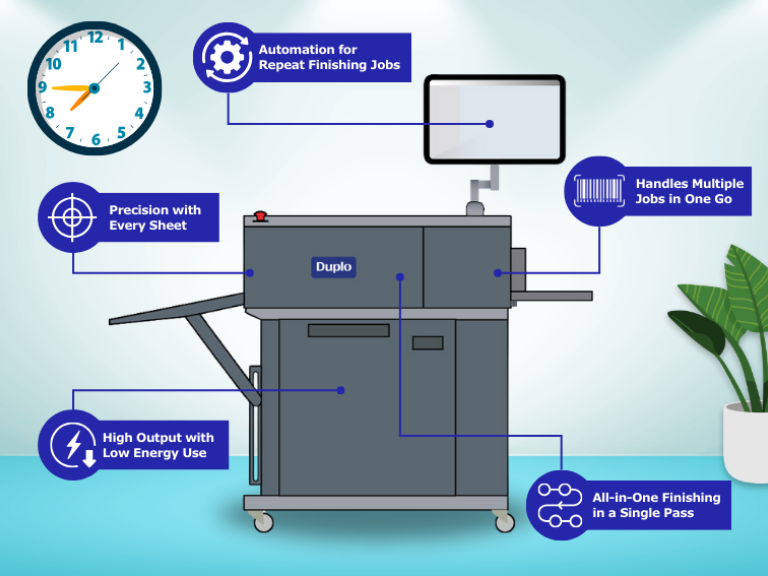
Solutions like the Duplo DBM-150 are designed for this type of environment, combining automated setup with compact production in a system that can produce finished booklets from flat sheets in a single workflow. With production speeds of up to 2,400 booklets per hour, it offers an accessible route into automated booklet making without requiring a large production footprint.
This type of setup is often a good fit for:
- Businesses bringing booklet production in-house for the first time
- PSPs looking to reduce reliance on manual finishing processes
- In-plants and smaller print operations where space is at a premium
- Teams looking for a straightforward route into automated booklet production
See how print businesses are using the DBM-150
Improving consistency as demand grows
As booklet volumes increase, production challenges tend to shift.
The focus becomes less about simply producing booklets and more about maintaining consistency across a wider range of jobs, operators, and turnaround expectations. Setup times, repeatability, and workflow efficiency begin to have a much greater impact on production.
This is where more scalable booklet making systems can make a significant difference.
Solutions like the Duplo DBM-350 are designed to support growing production environments that need greater flexibility without adding unnecessary complexity. Automated setup, stored job recall, and support for a broad range of booklet sizes help businesses move between jobs quickly while maintaining reliable output.
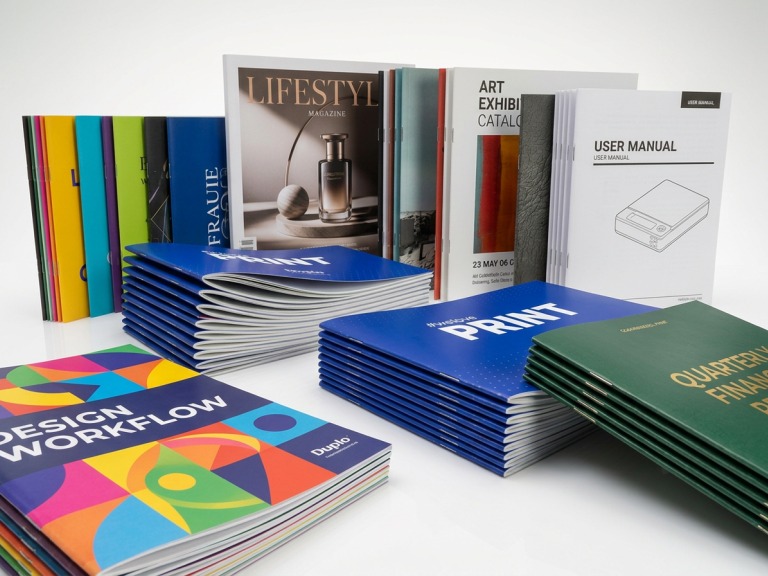
The optional square spine module also allows businesses to produce flatter, more premium-looking booklets while retaining the flexibility and efficiency of saddle stitching.
This type of setup is often suited to:
- Growing PSPs handling a broader range of booklet applications
- Businesses looking to improve consistency across different operators and job types
- Production environments where fast setup and repeatability are important
- Teams needing greater flexibility without moving to a larger production system
See how print businesses are using the DBM-350
Adding premium finishes and higher throughput
As production grows further, many businesses begin looking for ways to increase throughput while also adding more value to finished applications.
This is especially true for catalogues, magazines, reports, lookbooks, and other applications where presentation plays an important role in perceived quality.
At this stage, automation becomes increasingly important – not just for speed, but for reducing setup times and keeping production moving efficiently across multiple jobs.
Solutions like the Duplo DBM-700 are designed around these types of workflows, combining stitching, folding, trimming, and optional square spine finishing into a highly automated booklet production system. Capable of producing up to 5,200 booklets per hour, the DBM-700 is built to support demanding production environments.
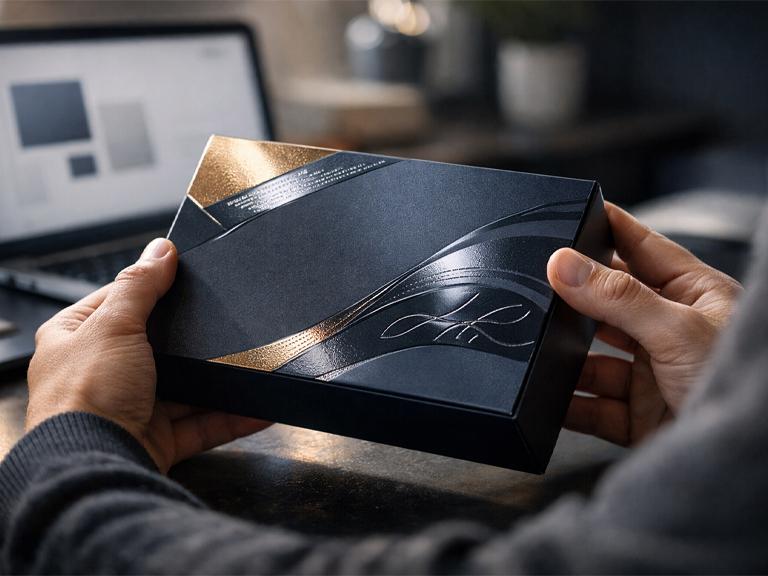
The addition of a square spine module allows businesses to create flatter booklets with a more premium appearance, helping saddle stitched applications achieve a finish often associated with perfect bound books, while maintaining the versatility and efficiency of stitched production.
This type of setup is often well suited to:
- Commercial print providers looking to increase throughput and productivity
- Businesses producing premium applications such as catalogues, magazines, and reports
- Production environments where automation and efficient changeovers are important
- Printers looking to add premium square spine applications while retaining the versatility of saddle stitching
See how print businesses are using the DBM-700
Handling more complex applications efficiently
Not every booklet production environment is driven purely by volume.
For many PSPs, the challenge lies in managing a wider variety of applications efficiently while maintaining quality and reducing setup times between jobs.
This can include:
- Variable page counts
- Different sheet sizes within the same booklet
- Covers with flaps or inserts
- Personalised or short-run applications
In these environments, flexibility and intelligent automation become critical.
The Duplo iSaddle 5.0 is designed specifically for this type of production, combining automated setup with intelligent feeding and support for a broad range of booklet formats and applications. With production speeds of up to 5,050 booklets per hour, it allows businesses to handle more varied work without compromising efficiency.
Its ability to produce complex applications while minimising changeover times makes it particularly valuable for businesses focused on differentiation and value-added print.
This type of setup is often suited to:
- PSPs producing a wide variety of booklet formats and applications
- Businesses handling personalised, versioned, or short-run work
- Production teams looking to reduce setup times between jobs
- Operations focused on expanding their application offering
See how print businesses are using the iSaddle 5.0
Scaling high-volume production environments
For larger commercial print environments, booklet production is often about maintaining efficiency at scale.
As run lengths become shorter and turnaround expectations continue to tighten, production systems need to combine speed with automation, reliability, and reduced operator intervention.
This is where high-performance saddle stitching systems become increasingly important.
Built on the foundations of the iSaddle platform, the Duplo iSaddle SENSHI is designed for high-volume environments that require intelligent automation and continuous productivity. It supports thicker booklets, automated changeovers, simultaneous block changes, and intelligent feeding systems designed to reduce stoppages and minimise operator burden.
The system is built around the idea of keeping production moving efficiently, even in demanding environments handling a high mix of shorter-run work.
This type of setup is often suited to:
- Large commercial print operations handling a high mix of booklet work
- Businesses looking to increase productivity without compromising quality
- Production environments where reducing makeready and stoppages is critical
- Teams focused on automation, scalability, and operational efficiency
See how print businesses are using the iSaddle SENSHI
Choosing the right booklet making solution
The right booklet maker depends on more than production speed alone.
For some businesses, the priority is bringing finishing in-house and improving control. For others, it may be about increasing consistency, reducing setup times, expanding application range, or scaling production efficiently.
Understanding where your workflow is today – and where you want it to go next – is often the best place to start.
Whether you are looking for a compact entry point into automated booklet making or a highly automated saddle stitching system built for large-scale production, the right solution should support both your current workload and your future growth.
Explore the next step
Discover the full Duplo booklet maker range and see which solution best fits your production needs. For tailored guidance, speak to your local distributor or the Duplo team, who can help you find the right fit for your workflow, applications and future growth.