In many print finishing departments, there is still someone who “just knows.”
They know how much pressure to apply on a crease.
They know how to adjust a cut instinctively.
They know when something doesn’t feel quite right – even before it becomes a problem.
That kind of experience is invaluable. It has been built over decades. But across the industry, a shift is happening. Teams are changing. Skilled operators are retiring. And replacing that depth of knowledge quickly isn’t always realistic.
The real question isn’t whether experience will leave the building. It’s what happens operationally when it does.
Finishing Is Often More Exposed Than Print
Digital print has evolved rapidly over the last decade. Workflows are automated. Files are controlled. Output is increasingly predictable.
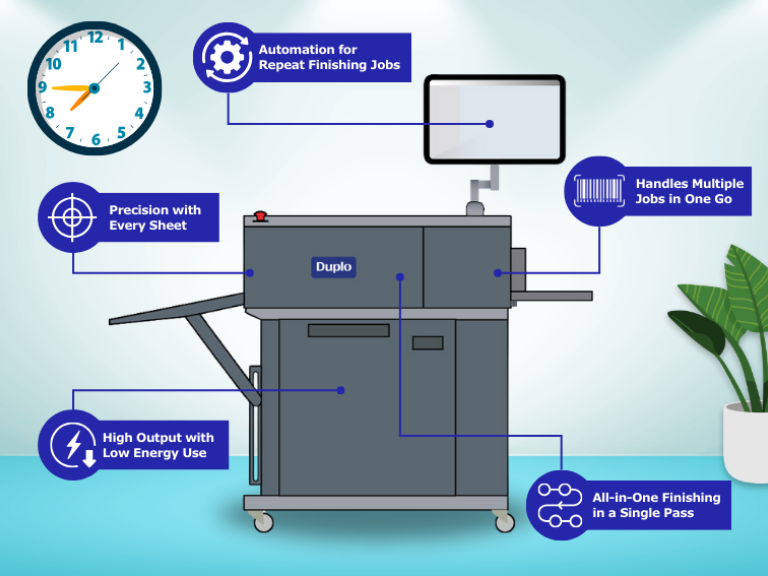
Finishing, however, has traditionally depended on operator skill. Setup, adjustment and consistency have often relied on the judgement of experienced individuals – which worked when teams were built around that expertise. Today, finishing no longer has to depend so heavily on individual interpretation. Systems such as the DC-618 embed setup logic and repeatability into the equipment itself, allowing knowledge to sit within the workflow rather than with one person.
At Ronset, when a key finishing role changed just as demand was increasing, the solution wasn’t to replace that experience like-for-like. It was to stabilise the process. By implementing the DC-618, finishing became guided and repeatable – reducing reliance on individual judgement and ensuring output remained consistent across the team.
The Risk of Knowledge Concentration
Every business accumulates knowledge. The challenge arises when that knowledge is concentrated in one or two people rather than embedded in the workflow itself.
In finishing, this might look like:
- Setup logic known only by one operator
- Workarounds developed through years of experience
- Troubleshooting based on instinct rather than repeatable process
Over time, that knowledge becomes part of the business’s rhythm. But it also becomes a point of vulnerability.
From Skill-Based to System-Based Finishing
Finishing is gradually shifting from being primarily skill-based to being system-supported. That shift does not remove the value of experienced operators. Instead, it captures and standardises best practice within the workflow itself. Guided setup, stored job recall, and repeatable parameters reduce reliance on interpretation. Work can be prepared once and executed consistently – regardless of who is operating the equipment.
At Impremta Palafrugell in Spain, consolidating cutting, creasing and perforating into one connected workflow with the DC-618 dramatically reduced production time while allowing a small team to manage peak seasonal demand more confidently.
Similarly, printers such as Tsiakkas Digital Printing have adopted integrated finishing solutions to simplify hand-offs and bring greater control to the final stages of production with the DC-618 and DC-F100 inline folder.
The common thread is not speed. It is predictability.
What Predictable Finishing Actually Changes
When finishing becomes predictable, the impact extends beyond the finishing department.
It changes:
- Risk exposure – because knowledge is embedded in the system.
- Onboarding time – because processes are repeatable.
- Consistency – because setup is guided rather than improvised.
- Commercial stability – because short runs remain viable.
For businesses like Minuteman Press Bath, increasing capacity and reducing turnaround times was as much about workflow structure as it was about throughput. When finishing behaves consistently, it supports the smaller, more frequent jobs that now define the market.
Predictability protects margin. It also protects confidence.
It’s Not About Replacing People
This evolution is sometimes misunderstood.
Moving toward guided, connected workflows is not about replacing skilled operators. Experienced finishing professionals remain critical to quality, oversight, and continuous improvement.
What changes is where the risk sits. Instead of risk being concentrated in individuals, it is distributed across a structured process. Teams are supported rather than stretched. Knowledge becomes transferable rather than vulnerable. In practical terms, that means finishing can continue smoothly – even when teams evolve.
Building Resilience into Finishing
Print finishing hasn’t necessarily become harder. In many ways, the equipment has become more capable than ever. What has changed is predictability. Teams change. Workloads fluctuate. Expectations rise.
The businesses adapting successfully are those embedding resilience into their workflows – ensuring that when experience leaves the building, the system continues to perform exactly as expected.
The question is no longer whether finishing depends on experience. It’s whether your finishing workflow is designed to carry that experience forward – every day, regardless of who is on shift.
If your finishing workflow still relies heavily on individual experience, now may be the right time to assess how it could be strengthened. Learn more about the DC-618 Slitter Cutter Creaser and DC-F100 Inline Folder, or contact Duplo International to discuss how a more connected, repeatable finishing workflow could support your business.