While the online sphere has become notorious for facilitating the spread of misinformation or disinformation, roughly 56% of customers trust print marketing. Also, while online ads can be simply skipped or blocked, people tend to (at least temporarily) keep hold of print publicity materials they receive.
It’s not hard to see, then, why print marketing can attract attention. However, the onus would still be on the marketer to sustain that attention — and this is where the quality of the materials can really come in.
Naturally, many business owners who turn to you won’t want recipients of their brochures, leaflets, and other forms of print marketing to just bin them straight away. For this reason, print designs shouldn’t be made in a slapdash manner. Entrepreneurs are advised to weigh up various print finishing options.
The term ‘print finishing’ can serve as a catch-all term for any processes that enhance the appearance, feel and durability of a printed sheet after it comes off the printing press. There are many types of print finishing, of which the most popular include cutting, folding, and slitting.
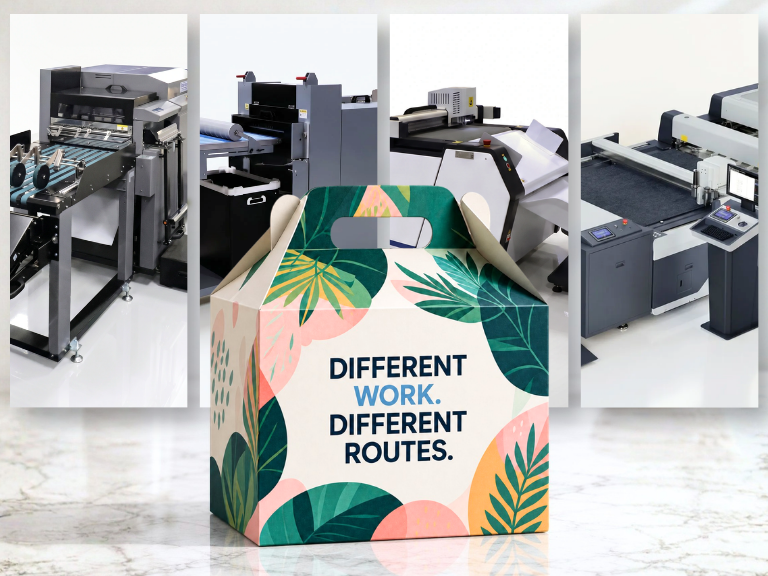
Still, before your PSP can provide any of these services for clients, it will need the right print finishing equipment. We at Duplo International would be happy to assist print businesses by providing them with print-finishing machines from all of the following categories.
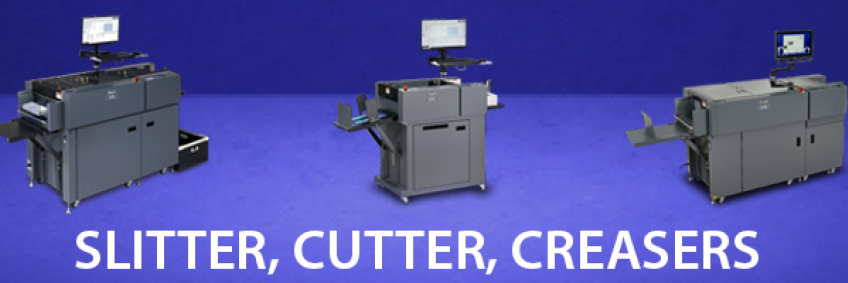
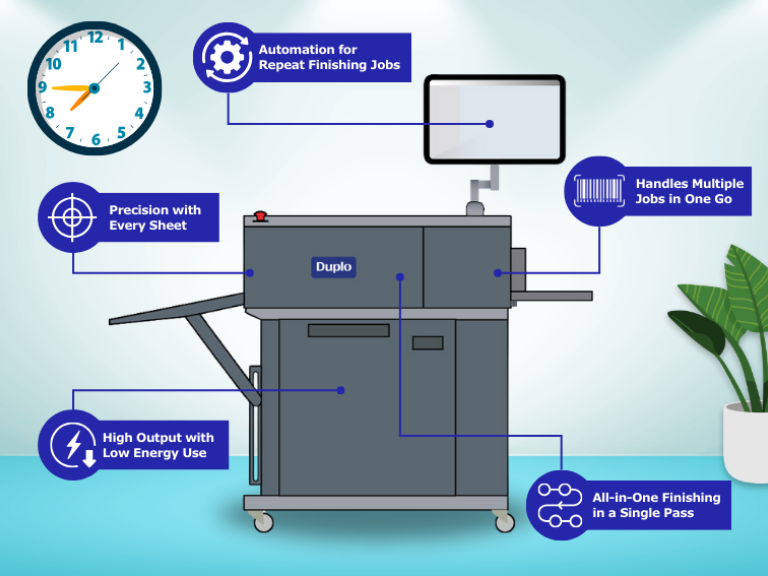
A Duplo slitter cutter creaser is an all-in-one unit capable of, yes, slitting, cutting and creasing — and, for that matter, perforating — all in one pass.
This multifaceted finishing functionality can be instrumental in helping your PSP to simplify and speed up the production of flyers, brochures, menus, invitations, and perforated vouchers.
For example, when a slitter cutter creaser is in full flow, the machine can reduce the number of errors that creep in. Remember that having to redo a printing job can cost you money and risk increasing waste.
It’s also worth heeding that just one Duplo slitter cutter creaser can deliver all of the same functionality that would be available collectively from all of these individual print finishing machines:
- Guillotine
- Die cutter
- Creaser
- Perforator
So, if your workplace currently has a large number of those separate machines, it won’t be hard for you to see how replacing them all with slitters cutters creasers from Duplo International could free up a lot of space. It can also minimise the number of touch points your workers need to deal with.
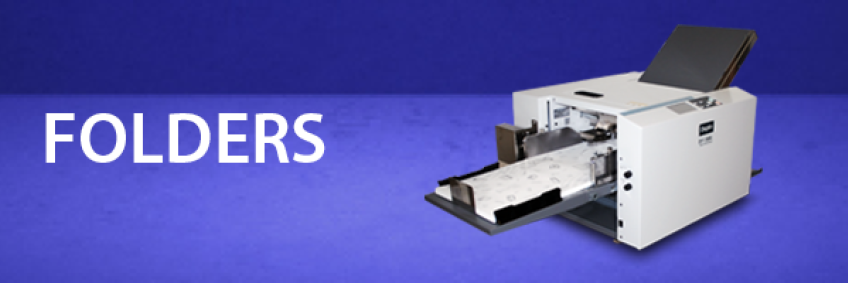
In print finishing, folding is a crucial step in creating newsletters, magazines, and brochures.
Though you could — if you wish — do that folding manually when producing such pieces for clients, you could find yourself achieving a much tidier-looking result by largely leaving the responsibility to a print folding machine.
Key to the appeal of such a machine is that it would enable you to get a lot of folding done within a relatively short space of time without compromising on the quality of the folds. It’s also possible for folding to be combined with other finishing processes, like cutting and binding.
We at Duplo can give you either of the following types of print folding machine:
- Friction feed: Our paper folding units in this category are easy and flexible to use while also remaining compact in size — making them well-suited to use in offices where space is at a premium but, on a regular basis, letters, flyers, and invoices need to be speedily folded.
- Suction feed: This term is reserved for digital print finishing solutions where colour is very much the order of the day. A suction feed model can be an especially good choice if many of your PSP’s clients are creative businesses eager to distribute visually quirky promotional material.
With both the friction feed and suction feed ranges of paper folding machines from Duplo, an intuitive control panel comes as standard. With it, the unit’s settings can be quickly and smoothly changed as and when necessary to accommodate a variety of paper formats.
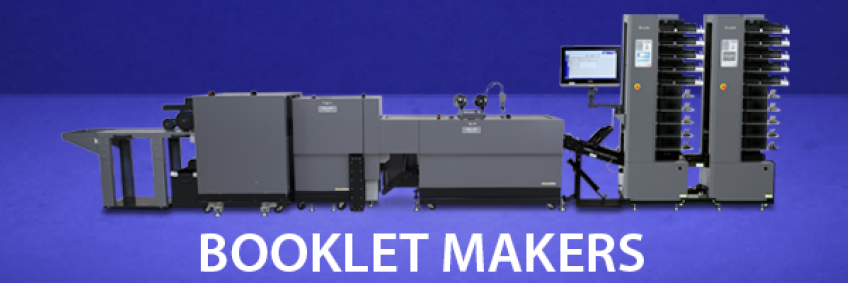
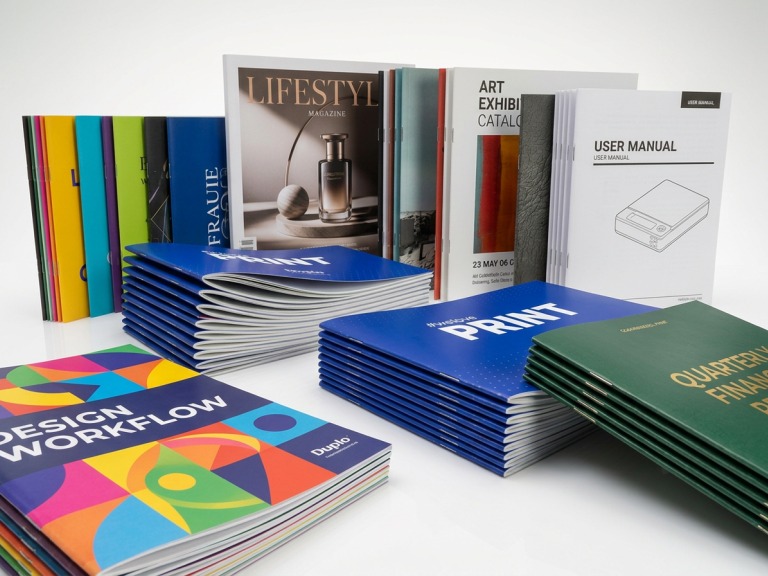
We offer many print finishing machines that can be used for binding pages together. The booklet makers and binders in our stock have been designed and built to create — between them — all of the following:
- Books
- Booklets, e.g. step booklets
- Brochures
- Catalogues
- Manuals
- Notepads
It seems logical to assume that the more high-end the print finishing equipment you source for binding purposes, the wider the range of binding processes it will be able to deliver.
Here are some examples of what types of binding are possible with our print finishing equipment:
- Saddle stitching: The most common approach to bookbinding, and perhaps unsurprisingly so when you consider how easy, quick, and inexpensive it is to do. It involves using a stapler to combine sheets of paper, making saddle stitching a sensible choice for small booklets.
- Perfect binding: With this procedure, the pages are held together with adhesive glue. As this technique is ideal for achieving clean, professional-looking results, it is especially well-suited to large booklets and catalogues, where imperfections could otherwise stand out too easily.
- Case binding: The tangibility of printed adverts means that they can stay around for years. You could further enhance this potential for longevity by producing durable hardback books — as case binding would allow you to do — for clients seeking to use them as promotional materials.
- Wire binding: This method entails securing pages together with metal wires. You might have already seen this kind of binding on notebooks and calendars, but it’s also an attractive option for larger booklets. In all of these instances, professionalism will be at the aesthetic forefront.
- Coil binding: This binding has much in common with wire binding — including its professional appearance, popularity for calendars and notebooks and suitability for larger booklets. Coil binding is so-called as it specifically uses a metal or plastic coil.
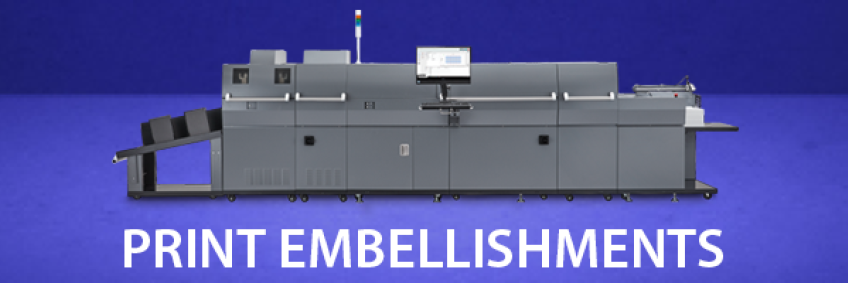
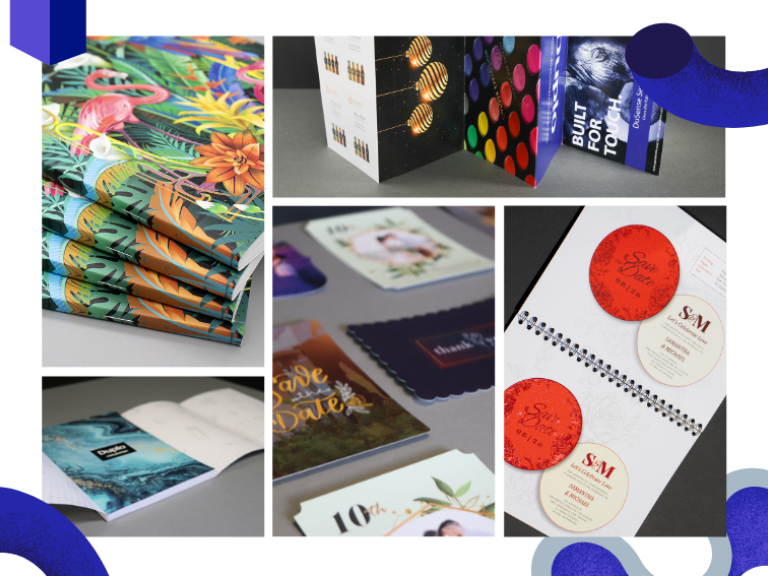
What does it mean to embellish a print? For PSPs that use Duplo print finishing machines to do so, it means creating physically raised or depressed textures or designs on a sheet. Duplo print finishing machines provide embellishment effects, such as:
- Embossing and debossing: These work in similar ways, but while embossing is about raising specific parts of a print, the purpose of debossing is to make depressions in the surface.
- Spot UV coating: Spot UV coating can add a clear but reflective finish to specific imagery that needs highlighting - like a logo.
- Metallic and pearlescent coating: As you might have guessed, this type of coating leaves a shimmering surface intended to catch the light and draw attention as a result.
- Aqueous coating: It isn’t ideal for print marketing pieces to be accidentally stained, creased, or torn, but giving them this water-based clear coating can help to prevent such damage.
Digital Cutting Tables & Die-Cutting
It’s not hard to cite scenarios where some degree of cutting would be required for a print project. Often, prints don’t arrive in just the right size for a given project. Consequently, you may need to trim the sheet.
You might even be asked to cut specific, perhaps rather unorthodox shapes out of prints. Fortunately, you could fulfil this request by using a die-cutting machine on the material in question.
Duplo International provides future-proof solutions, including a digital cutting table built to accommodate sheets in B2 size. This table can give you a big helping hand in the finishing of stickers, labels, invitations, tags, and other printed pieces.
Contact Duplo International for more information, today
If you have questions about these products or any others we make, Contact Duplo International, today.